 GuideWhale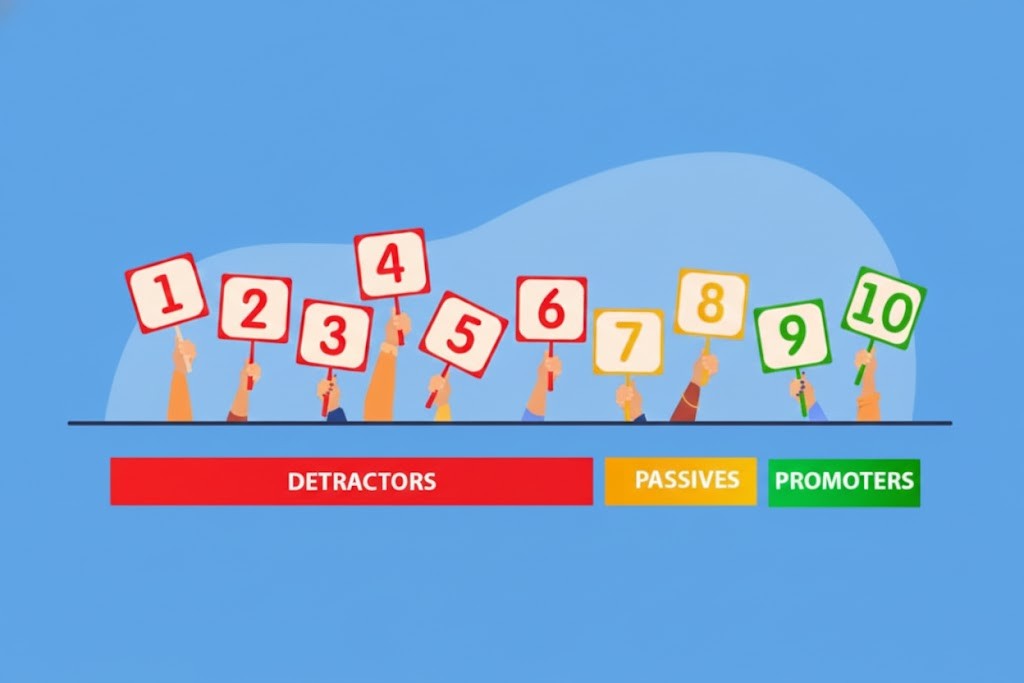

NPS: The One Question That Tells You If Users Actually Like Your Product
"On a scale of 0-10, how likely are you to recommend us to a friend?" That's it. That's the whole survey. And somehow this single question has become one of the most reliable ways to measure whether your SaaS is actually working for people.
NPS (Net Promoter Score) isn't magic, but it's useful. It gives you a number you can track over time, and more importantly, it opens a conversation with users about what's working and what isn't.
How It Works
Based on their answer, users fall into three buckets:
- Promoters (9-10) — These people genuinely like your product. They'll tell others about it.
- Passives (7-8) — They're fine with it. Not excited, not upset. Vulnerable to competitors.
- Detractors (0-6) — Something's wrong. They might be actively warning people away from you.
Your NPS = % Promoters minus % Detractors. The score ranges from -100 (everyone hates you) to +100 (universal love). Most SaaS companies aim for 30+. Really good ones hit 50+.
Why Bother?
It predicts growth. Promoters refer people. Detractors don't. Simple math.
It's an early warning system. NPS often drops before churn spikes. If you're paying attention, you can fix problems before they cost you customers.
The follow-up question is gold. "Why did you give that score?" gets you actual feedback. The number tells you something's wrong; the text tells you what.
When to Ask
Timing matters. Ask too early and users haven't formed an opinion. Ask too late and the unhappy ones have already left.
For most SaaS products:
- First survey after 30-60 days (they've had time to actually use it)
- Then quarterly for ongoing relationship tracking
- After specific moments—finishing onboarding, resolving a support ticket, trying a new feature
- When someone cancels (exit surveys are painful but informative)
Getting Good Data
Ask in-app. Email surveys get ignored. In-app prompts when someone's actively using your product get 3-5x better response rates.
Always ask why. The score without context is just a number. The explanation is where you learn something.
Segment the results. Your overall NPS might be 40, but maybe enterprise customers are at 60 and small teams are at 20. That's a different problem than a flat 40 across the board.
Don't survey people to death. Once a quarter is plenty. More than that and you're just annoying people.
What to Do With the Results
Promoters: Ask for testimonials. Invite them to refer friends. Figure out what they love and do more of it. Consider them for beta programs—they'll give you honest feedback because they want you to succeed.
Passives: These are your biggest opportunity. They're not unhappy, just not impressed. Find out what would make them a 9 or 10. Often it's a feature they don't know about or a use case they haven't tried.
Detractors: Reach out fast. These users are at high churn risk and might be telling others to avoid you. Sometimes you can save them by fixing their specific issue. Sometimes they're just a bad fit. Either way, you need to know.
Mistakes to Avoid
Treating NPS as your only metric. It's one signal. Combine it with retention, engagement, and revenue data for the full picture.
Collecting feedback and doing nothing. If you ask people what's wrong and then ignore them, you've made things worse. They feel unheard.
Ignoring Passives. Everyone obsesses over Promoters and Detractors. But Passives are the swing voters. A small improvement could turn them into advocates.
Gaming the score. Only surveying happy customers or cherry-picking timing defeats the purpose. You want honest feedback, not a number to put on a slide.
The score matters less than the trend. A company improving from 20 to 35 is in better shape than one stuck at 40.
Getting Started
Keep it simple. Set up an in-app NPS survey for users who've been active for at least 30 days. Tools like GuideWhale make this easy to deploy without engineering work.
Track your baseline, read the feedback, make improvements, and survey again in a few months. NPS isn't a destination—it's a compass. Use it to figure out where to go next.